Every year, millions of people walk into aptitude tests believing they are not smart enough to succeed. They spend hours memorizing formulas, watching endless videos and solving random exercises — yet when the pressure begins, their minds freeze, their speed disappears and their confidence collapses.
The truth is brutal: most candidates do not fail because they lack intelligence. They fail because they never trained their brains to think under pressure.
Logical reasoning, mental speed and problem-solving are not natural gifts reserved for a few exceptional people. They are trainable skills — just like strength, endurance or discipline. The human brain adapts to the level of challenge it faces every day.
Elite performers understand something most people ignore: success in competitive exams is not only about knowledge. It is about focus, pattern recognition, speed, decision-making and mental resistance.
That is why this challenge was created.
Over the next 30 days, you will discover a different approach to aptitude training — one designed to sharpen your reasoning, accelerate your thinking and help you perform at a much higher level in exams, assessments and competitive tests. 🚀
WHAT IS AN APTITUDE TEST? 🧠🌍
In today’s competitive world, aptitude tests have become one of the most powerful tools used to measure a person’s ability to think, analyze and solve problems under pressure. These assessments are no longer limited to schools or academic environments — they are used globally by governments, multinational companies, military organizations and major financial institutions to identify candidates capable of performing at a high level. 🚀
Unlike traditional exams that focus mainly on memorization, aptitude tests evaluate how efficiently your brain processes information. They are designed to test your reasoning, mental agility, decision-making speed and problem-solving capacity in real-time situations. That is why many intelligent people still struggle with these exams: knowledge alone is not enough. The brain must also be trained for performance. ⚡
Logical Reasoning 🔍
Logical reasoning is the foundation of aptitude testing. It measures your ability to identify relationships, recognize structures and make correct decisions based on patterns and evidence.
Candidates are often challenged with sequences, analytical situations, symbols, diagrams and logic-based scenarios that require fast thinking and precision. The objective is not simply to “know the answer,” but to demonstrate structured thinking and cognitive control under pressure.
This skill is heavily used in:
- ✔ competitive exams 🌍
- ✔ intelligence and military selection 🪖
- ✔ technology companies 💻
- ✔ management recruitment 📈
Strong logical reasoning allows candidates to eliminate wrong alternatives quickly, identify hidden patterns and make strategic decisions faster than average competitors.
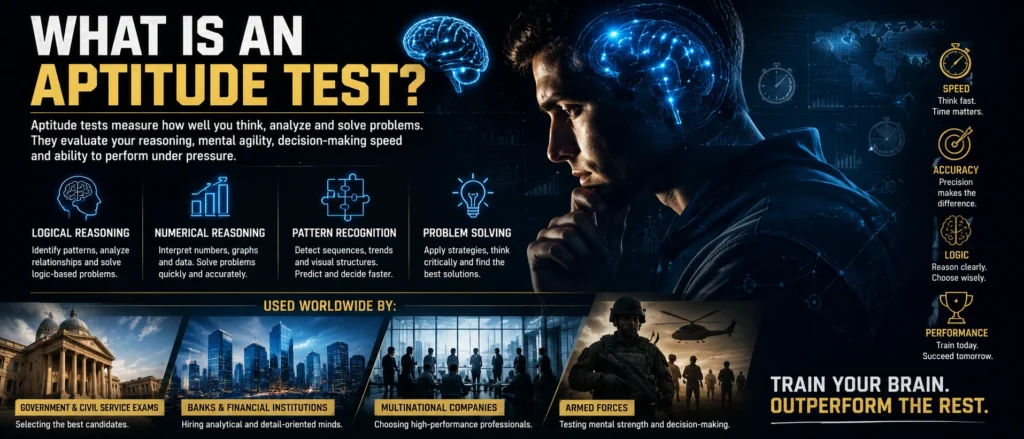
Numerical Reasoning 📊
Numerical reasoning evaluates how well a person understands and manipulates numerical information. However, these tests are rarely about advanced mathematics. In most cases, they focus on speed, interpretation and mental efficiency.
Candidates may face:
- ✔ tables
- ✔ percentages
- ✔ graphs
- ✔ financial data
- ✔ numerical comparisons
The real challenge is solving problems accurately within a limited amount of time. ⏱️
Banks, multinational corporations and consulting firms use numerical reasoning tests extensively because they reveal how a person reacts to data, pressure and decision-making scenarios.
A candidate who can process numbers quickly usually demonstrates:
✔ analytical thinking
✔ concentration
✔ mental organization
✔ performance under stress
Pattern Recognition 🧩
One of the most fascinating aspects of aptitude tests is pattern recognition — the brain’s ability to detect order, predict sequences and identify hidden relationships.
This type of evaluation is common in:
- IQ tests
- military assessments
- engineering recruitment
- high-performance selection processes
The brain naturally searches for patterns to make decisions faster. Aptitude tests explore this mechanism intensely.
Visual sequences, geometric transformations and symbolic logic are frequently used to challenge cognitive flexibility and mental adaptation. The faster the brain recognizes patterns, the faster it can solve complex problems. ⚡🧠
Problem Solving 🚀
At the highest level, aptitude tests measure something even more important than knowledge: the ability to solve problems efficiently.
Problem solving combines:
- logic
- interpretation
- strategy
- emotional control
- speed
This is why many organizations around the world use aptitude tests before hiring employees or selecting elite candidates.
Major multinational companies 🌐, government agencies 🏛️ and military forces 🪖 are not only searching for people who know information — they are searching for individuals capable of making good decisions under pressure.
And this is exactly where mental training becomes a competitive advantage.
The more you train your brain to think strategically and react quickly, the more naturally your mind performs during difficult tests and high-pressure situations. 🔥
WHY MOST PEOPLE FAIL 🚨🧠
Every year, millions of candidates dedicate countless hours to studying for aptitude tests, competitive exams and selection processes. They watch videos, read books, memorize formulas and solve exercises repeatedly. Yet when the real test begins, many of them suddenly freeze under pressure. Their minds slow down, simple calculations become difficult and logical reasoning disappears almost instantly. ⚠️
This happens because most people prepare in the wrong way.
The human brain was not designed to perform well merely through memorization. Real performance under pressure depends on cognitive adaptation — the brain’s ability to process information quickly, stay emotionally stable and make efficient decisions in stressful situations.
Unfortunately, traditional study methods ignore this completely.
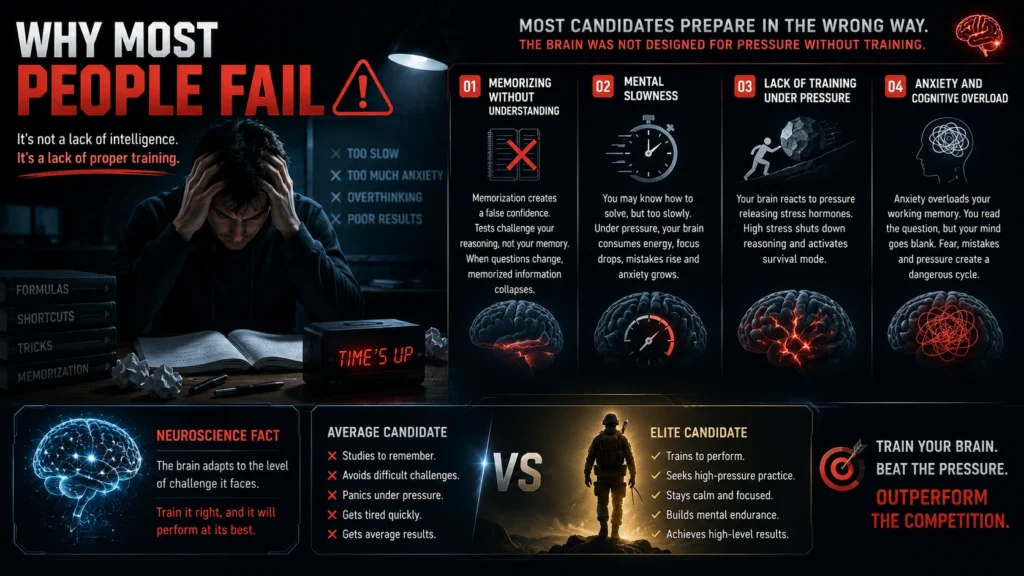
Memorizing Without Understanding 📚❌
One of the biggest mistakes candidates make is believing that success comes from memorizing formulas and procedures mechanically.
For a short period of time, memorization may create the illusion of confidence. However, aptitude tests are designed to challenge reasoning, not repetition. The moment the brain encounters an unfamiliar question or a different pattern, memorized information becomes fragile.
High-level tests intentionally force candidates to think, adapt and interpret under pressure. That is why people who memorize everything often collapse when facing unexpected scenarios.
The brain performs far better when it understands concepts deeply instead of simply storing isolated information. 🧩
Mental Slowness Under Pressure ⏱️
Another major problem is mental speed.
Many candidates know how to solve problems — but they solve them too slowly. In competitive environments, speed becomes a weapon. The ability to process information rapidly often separates average performers from elite candidates.
Under pressure, the brain consumes enormous amounts of energy. If it has never been trained for fast decision-making, cognitive fatigue appears quickly:
- 🎯concentration decreases
- ❌ mistakes increase
- 😰anxiety grows
- 🧠⚠️ reasoning becomes unstable
This is why mental speed training is essential. Just like muscles adapt to physical training, the brain adapts to cognitive pressure through repetition and challenge. ⚡
The Brain Reacts to Pressure Like the Body Reacts to Stress 🧠🔥
Neuroscience shows that stressful situations activate survival mechanisms inside the brain. When pressure increases, the body releases stress hormones such as cortisol and adrenaline.
In moderate levels, these hormones can improve focus. But when anxiety becomes excessive, the brain starts prioritizing survival instead of reasoning.
This explains why many intelligent candidates suddenly forget simple concepts during exams.
Their problem is not lack of intelligence.
Their brain simply was never trained to remain calm and efficient under pressure.
Elite performers understand something crucial:
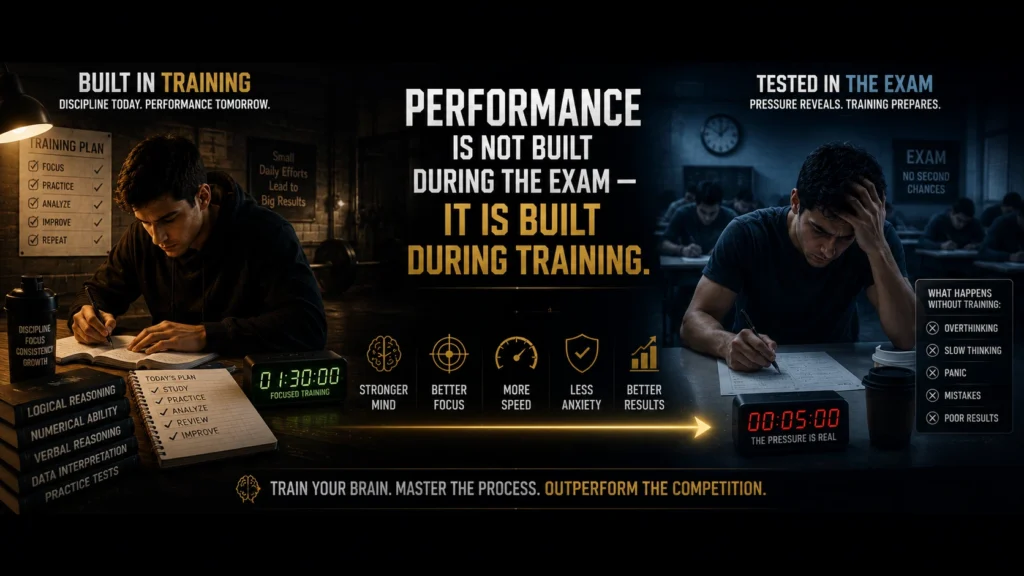
performance is not built during the exam — it is built during training.
Anxiety and Cognitive Overload 🌪️
Anxiety is one of the biggest hidden enemies in aptitude tests.
When the brain becomes overloaded with fear, self-doubt and pressure, working memory starts to collapse. The candidate may read the same question multiple times without fully understanding it.
This creates a dangerous cycle:
- fear causes mistakes
- mistakes increase anxiety
- anxiety reduces reasoning ability
The result is frustration, exhaustion and low performance.
That is why successful candidates do not train only knowledge. They train focus, emotional control, mental endurance and cognitive resistance. 🪖
The Difference Between Average and Elite Candidates 🚀
Most people study to remember information.
Elite candidates train to perform under pressure.
That difference changes everything.
When the brain is exposed repeatedly to logical challenges, timed exercises and high-pressure simulations, it gradually becomes faster, calmer and more efficient.
The objective is not merely to “study harder.”
The objective is to train the brain to think clearly when pressure arrives. 🔥
YOUR BRAIN CAN BE TRAINED ⚡🧠
One of the greatest misconceptions about intelligence is the belief that mental performance is fixed. Many people grow up believing they are either “naturally smart” or simply not capable of performing at a high level in competitive environments.
Modern neuroscience proves the exact opposite.
The brain is not static. It is adaptable, dynamic and constantly changing according to the challenges it faces every day. This incredible ability is known as neuroplasticity — the brain’s power to reorganize itself, strengthen neural connections and improve performance through repetition and experience. 🚀
This means that logical reasoning, mental speed and problem-solving are not talents reserved for a small group of gifted individuals. They are trainable skills.
Every time you solve a problem, analyze a pattern or make a rapid decision under pressure, your brain creates and reinforces neural pathways. The more frequently these pathways are activated, the faster and more efficient your thinking becomes.
In simple terms:
👉 your brain becomes stronger through training.
Neuroplasticity: The Brain’s Superpower 🧩
For decades, scientists believed the brain stopped developing after a certain age. Today, research shows that the brain continues adapting throughout life.
When exposed to cognitive challenges repeatedly, the brain responds by:
- improving processing speed ⚡
- strengthening memory connections 🧠
- increasing focus 🎯
- optimizing decision-making 🚀
This is why elite performers train consistently. They understand that high performance is built through repeated exposure to difficulty and pressure.
Just like muscles grow after physical training, the brain evolves after mental training.
Repetition Creates Mental Efficiency 🔁
Repetition is one of the most powerful mechanisms of learning.
However, true cognitive repetition is not passive memorization. It is active engagement under challenge.
When the brain repeatedly solves logical problems, numerical exercises and timed situations, it gradually reduces mental resistance and increases efficiency.
Tasks that once required enormous effort begin to feel natural.
This is how elite candidates develop:
✔ faster reasoning
✔ sharper focus
✔ pattern recognition
✔ automatic decision-making
Mental training transforms complexity into familiarity.
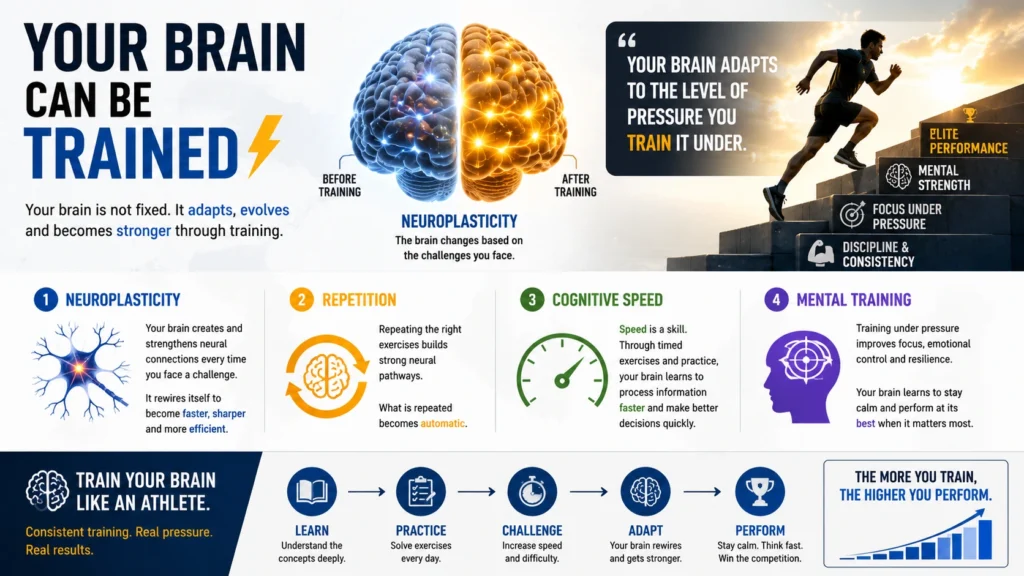
Cognitive Speed Can Be Developed ⏱️⚡
Many candidates believe they are “naturally slow thinkers.” In reality, most people simply never trained their brains for speed.
The brain adapts to the environment it experiences most often.
If a person studies slowly, without pressure or time limits, the brain becomes comfortable operating at that level.
But when exposed to:
- ⏱️timed exercises
- ⚡rapid problem-solving
- 🧩logical challenges
- 🧠🔥 cognitive pressure
…the brain starts developing faster processing mechanisms.
Over time, reaction speed improves dramatically.
This is why consistent aptitude training can make someone feel mentally “faster” after only a few weeks of focused practice.
Mental Training Under Pressure 🔥
Pressure changes everything.
During stressful situations, the brain must maintain:
- focus
- emotional control
- reasoning
- speed
Without training, pressure creates confusion and anxiety. But with repeated exposure, the brain gradually learns to remain calm and efficient.
Elite performers do not avoid pressure.
They train inside it. 🪖
This is one of the greatest secrets behind high-level performance:
“Your brain adapts to the level of pressure you train it under.”
The more your mind experiences controlled difficulty, the more resilient and powerful it becomes.
That is why true aptitude training is not about memorizing answers.
It is about conditioning the brain to think clearly, quickly and strategically — even when pressure is at its highest. 🚀
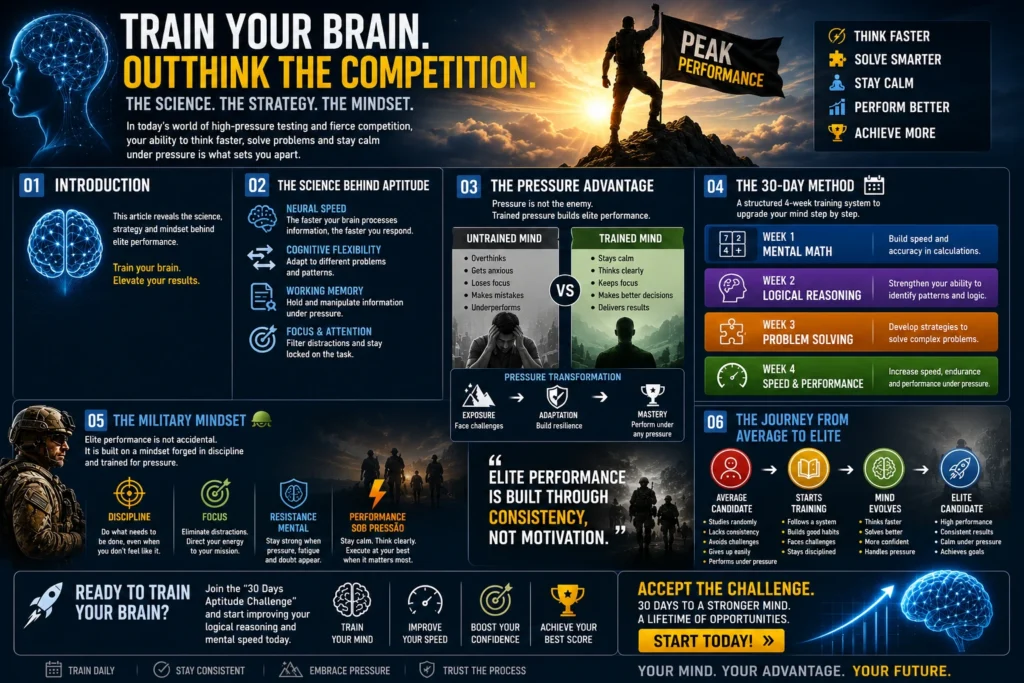
THE 30-DAY METHOD 📅⚡
Improving your performance in aptitude tests is not about studying randomly or consuming endless information without direction. Real progress happens when the brain is exposed to a structured training system capable of developing focus, reasoning speed and mental resilience step by step.
That is the purpose behind the 30-Day Method.
This training system was designed to transform the way your brain reacts to logical challenges, numerical pressure and timed situations. Instead of overwhelming you with complexity from the beginning, the method gradually increases cognitive intensity, allowing your brain to adapt, strengthen and perform at a much higher level over time. 🚀
Each week focuses on a specific mental skill essential for high performance in competitive exams, aptitude tests and selection processes worldwide.
WEEK 1 — MENTAL MATH ⚡🧮
The first stage focuses on building mental agility through fast numerical thinking.
Many candidates lose valuable time during exams because their brains depend excessively on calculators, written calculations or slow processing methods. The objective of this phase is to create speed, confidence and automatic numerical reactions.
During this week, the brain is trained to:
- ⚡process calculations faster
- 🔢 recognize numerical shortcuts
- 📊 improve estimation skills
- 🧠🚀reduce cognitive hesitation
Simple exercises performed consistently begin creating faster neural pathways, making calculations feel more natural and efficient over time.
Mental math is not about advanced mathematics.
It is about training the brain to think quickly under pressure. ⏱️
WEEK 2 — LOGICAL REASONING 🔍🧠
After improving numerical agility, the second phase develops analytical thinking and pattern recognition.
Logical reasoning is one of the most important skills in aptitude testing because it measures how efficiently the brain interprets structures, identifies relationships and makes decisions.
This stage exposes the brain to:
- 🔢sequences
- 🧩logical puzzles
- 👁️visual reasoning
- 📊 analytical situations
- 🎯 strategic elimination techniques
As the exercises become progressively more challenging, the brain starts recognizing patterns faster and reducing unnecessary mental effort.
The goal is not only solving problems correctly.
The goal is solving them with clarity, precision and speed. ⚡
WEEK 3 — PROBLEM SOLVING 🚀🔥
At this point, the training evolves beyond isolated questions.
The brain now begins learning how to deal with uncertainty, complexity and pressure simultaneously.
Problem solving combines multiple cognitive skills:
✔ reasoning
✔ interpretation
✔ strategy
✔ emotional control
✔ adaptability
During this phase, candidates face more realistic and demanding situations designed to simulate the pressure of real aptitude tests.
The objective is to strengthen mental endurance and teach the brain how to remain calm while processing difficult information quickly.
This is where confidence starts changing dramatically.
The candidate no longer reacts emotionally to problems.
The brain begins responding strategically. 🪖
WEEK 4 — SPEED & PERFORMANCE ⏱️🏆
The final stage transforms training into performance.
Here, the brain is exposed to timed challenges, rapid decision-making exercises and high-pressure simulations designed to maximize cognitive efficiency.
This phase focuses on:
- ⚡reaction speed
- 🎯focus under pressure
- 🧠🔥 mental resistance
- 📖⚡fast interpretation
- 🏆performance consistency
By this stage, many candidates notice something remarkable:
they no longer feel mentally “blocked” under pressure.
Their brains become faster, calmer and more adaptive.
Tasks that once felt overwhelming now feel manageable.
This is the result of repeated cognitive conditioning.
The objective of the 30-Day Method is not merely to improve test scores.
It is to create a stronger, faster and more resilient mind capable of performing under pressure when it matters most. 🚀🔥
THE MILITARY MINDSET 🪖🔥
High performance is rarely built in moments of comfort.
Whether in competitive exams, elite military training, high-pressure corporate environments or critical decision-making situations, the individuals who consistently outperform others usually share the same mental foundation:
discipline, focus, emotional control and resilience under pressure. ⚡
This is what can be called the Military Mindset.
It is not about aggression or extreme routines. It is about developing a mentality capable of maintaining performance even when motivation disappears, pressure increases and fatigue begins to dominate the mind.
Most people rely on motivation to study.
Elite performers rely on systems. 🚀
Discipline Creates Stability 🎯
Motivation is temporary.
Some days the mind feels energetic and focused. On other days, distractions, stress and exhaustion take control. Candidates who depend only on emotional motivation usually become inconsistent very quickly.
Discipline changes this completely.
Discipline allows the brain to continue moving forward regardless of emotions. It creates structure, repetition and consistency — the true foundations of long-term cognitive development.
This is one of the biggest differences between average and elite performers:
average candidates study when they feel motivated;
elite candidates train even when they do not feel like it.
Consistency builds mental strength. 🔥
Focus Is a Competitive Advantage 🧠
Modern environments constantly attack concentration.
Notifications, social media, anxiety and information overload reduce cognitive efficiency every day. As a result, many people spend hours “studying” without achieving deep mental engagement.
The Military Mindset trains the opposite:
✔ controlled attention
✔ deep focus
✔ mental presence
✔ execution under pressure
High-level performance requires the ability to eliminate distractions and direct mental energy toward a single objective.
The sharper the focus, the stronger the performance.
Mental Resistance Under Pressure ⚡
Pressure reveals weaknesses.
During aptitude tests and competitive situations, the brain experiences stress, uncertainty and emotional overload. Without training, these conditions generate panic, hesitation and cognitive collapse.
Mental resistance is developed through repeated exposure to difficulty.
This is why military training environments use controlled pressure:
not to break the mind,
but to strengthen it.
Over time, the brain learns how to:
- 😌remain calm
- 🧠think clearly
- ⚡adapt quickly
- 🔥continue performing under stress
The objective is not to eliminate pressure.
The objective is to become stronger inside it. 🪖
Performance Is Built Before the Test 🚀
Most people only discover their weaknesses during the exam itself.
Elite performers identify and train those weaknesses long before the pressure arrives.
That is the essence of the Military Mindset:
preparation before performance.
Every training session, every logical challenge and every timed exercise strengthens the brain’s ability to react efficiently in difficult situations.
The goal is not simply to study harder.
The goal is to build a mind capable of performing consistently at a high level regardless of pressure, fatigue or adversity.
Because in the end:
“Elite performance is built through consistency, not motivation.” 🔥
THE PATH TO ELITE PERFORMANCE 🚀🧠
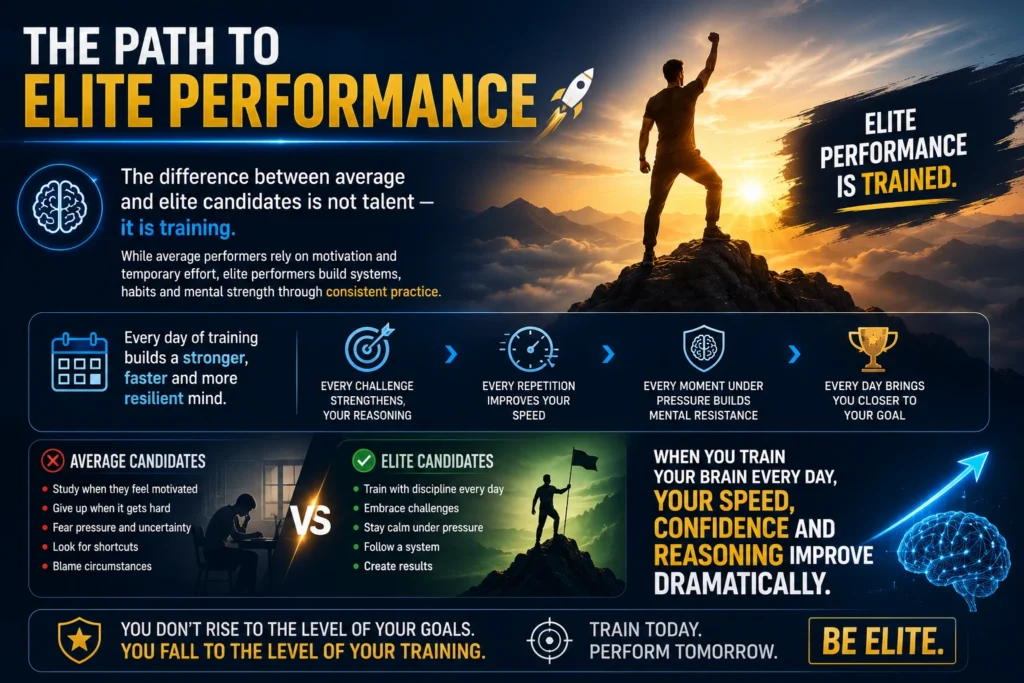
Most people spend years believing that high-level performance belongs only to naturally gifted individuals. They look at elite candidates and assume they were simply born smarter, faster or more talented.
But real performance does not come from talent alone.
It comes from training.
The difference between average and elite candidates is rarely intelligence. In most cases, it is the ability to remain disciplined, focused and mentally strong under pressure. While average performers rely on motivation and temporary effort, elite performers build systems, habits and cognitive resilience through consistent practice. ⚡
Every logical challenge solved, every timed exercise completed and every moment spent training under pressure strengthens the brain little by little. Over time, the mind becomes faster, calmer and more efficient.
This transformation does not happen overnight.
It happens through repetition, consistency and controlled exposure to difficulty.
When you train your brain every day, something remarkable begins to happen:
- your reasoning becomes sharper 🔍
- your confidence increases 🚀
- your mental speed improves ⚡
- pressure feels smaller 🪖
- difficult problems become manageable 🧠
That is the true objective of aptitude training.
Not simply passing a test —
but building a stronger version of yourself capable of performing at a high level whenever pressure appears.
Because in the end, elite performance is not accidental.
It is trained. 🔥
READY TO UNLOCK YOUR FULL MENTAL POTENTIAL? 🚀🧠
Every challenge you face, every problem you solve and every moment you train under pressure has the power to transform the way your brain performs.
Elite candidates are not born with special abilities.
They build them through discipline, repetition and consistent mental training. ⚡
Now it is your turn to develop:
✔ faster thinking
✔ sharper reasoning
✔ stronger focus
✔ higher confidence under pressure
✔ elite-level mental performance
The journey starts with one decision:
to train your brain differently from everyone else.
🚀 Join the “30 Days Aptitude Challenge” and begin strengthening your logical reasoning, cognitive speed and problem-solving abilities starting today.
Your future performance is being built right now. 🔥