🔢 See How 1×1 Guru Can Help My Child 🧮(Official Website)
Why Building Strong Math Skills in Childhood Matters More Than Ever
Artificial Intelligence is changing the way we study, work, search for information, and solve problems.
Today, a child can ask an AI tool to solve a math problem, explain an equation, check homework, or provide a complete step-by-step solution in just a few seconds.
This technology offers extraordinary opportunities for education.
However, it also raises an important question for parents:
If technology can provide almost every answer, will our children still learn how to find answers by themselves?
The goal should not be to keep children away from Artificial Intelligence.
AI will probably be an important part of their education, careers, and everyday lives.
The real challenge is different:
We must teach children how to use Artificial Intelligence without allowing it to replace their own thinking.
And one of the best places to start is with the foundations of mathematics.
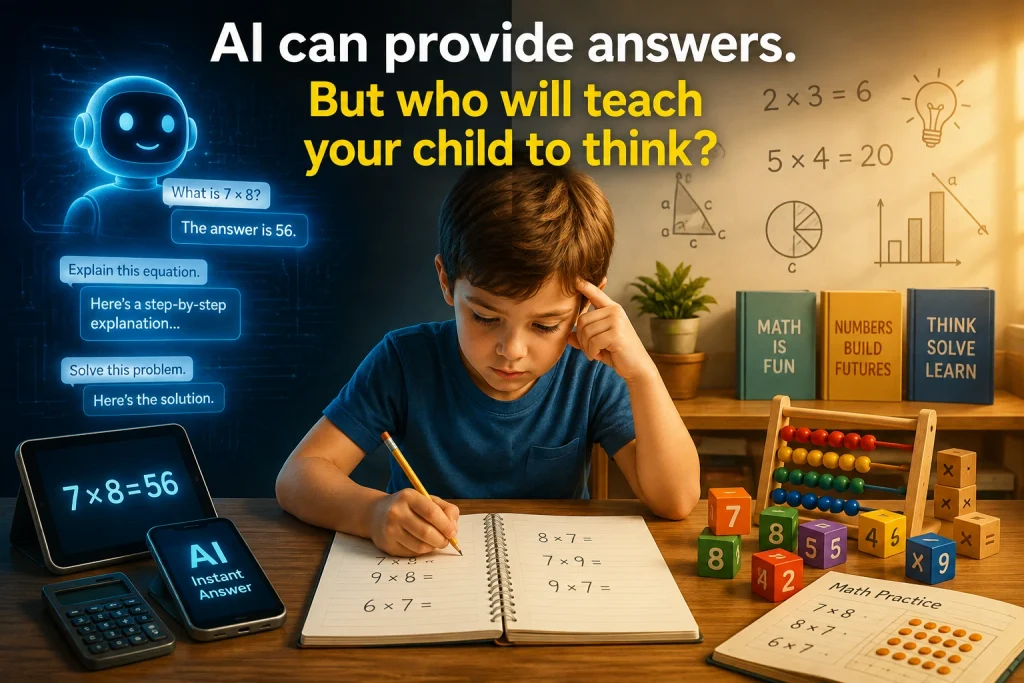
Suggested image: A child sitting at a desk between two worlds. On one side, a tablet, smartphone, calculator, and AI providing instant answers. On the other side, books, numbers, math blocks, and the child actively solving a problem.
Text on image:
“AI can provide answers. But who will teach your child to think?”
🔢 See How 1×1 Guru Can Help My Child 🧮(Official Website)
1. 🧠 A Child’s Brain Needs to Be Challenged
Learning requires effort.
When children learn something new, they need to observe, remember, make connections, test ideas, make mistakes, try again, and retrieve information from memory.
That mental effort is part of the learning process.
Think about physical exercise.
We cannot strengthen our muscles by watching someone else exercise for us.
The brain also needs opportunities to work.
When every small difficulty is immediately solved by an external tool, children may lose valuable opportunities to develop important skills such as:
- 🧠 Memory
- 🎯 Attention
- 🔢 Mental calculation
- 🧩 Problem-solving
- 💭 Logical reasoning
- 🔄 Information retrieval
- ⚡ Mental agility
This does not mean that children should stop using computers, smartphones, calculators, or Artificial Intelligence.
Technology can be extremely valuable.
The important point is that some fundamental abilities should be developed before they are constantly outsourced to technology.
🔢 See How 1×1 Guru Can Help My Child 🧮(Official Website)
2. ⚠️ The Problem Is Not AI — It Is Dependence on AI
A calculator is a wonderful tool.
Artificial Intelligence is an even more powerful one.
But imagine a child who cannot recognize that:
10 × 10 = 100
without asking a calculator or an AI assistant.
Now imagine that same dependence appearing in increasingly simple tasks.
The child is no longer using technology only to solve difficult problems.
Technology is being used to avoid the mental effort required to solve problems the child could reasonably solve alone.
This introduces one of the greatest educational challenges of the AI era:
The outsourcing of thinking.
Instant answers are comfortable.
Thinking requires effort.
And when an easier option is always available, it can become tempting to use it automatically.
For parents and teachers, a simple question may become increasingly valuable:
“Before we ask AI, how would you solve it?”
Give the child time to think.
Even a few seconds of independent reasoning can be valuable.
🔢 See How 1×1 Guru Can Help My Child 🧮(Official Website)
3. 🤖 A Generation Surrounded by Instant Answers
Previous generations had to search for information in books, libraries, encyclopedias, and classrooms.
Today’s children can receive an answer almost immediately.
Tomorrow’s children may have AI assistants integrated into almost every device they use.
This creates an extraordinary educational opportunity.
But it also creates a risk.
The easier it becomes to obtain an answer, the less necessary it may feel to remember, calculate, investigate, or reason independently.
Consider a simple question:
8 × 7 = ?
A child can ask AI.
The answer appears immediately:
56.
The problem has been solved by the machine.
But has the child learned anything?
Not necessarily.
There is an important difference between having access to information and possessing knowledge.
🔢 See How 1×1 Guru Can Help My Child 🧮(Official Website)
4. 🔢 Why Mathematics Is a Great Place to Start
Mathematics provides children with continuous opportunities to develop reasoning.
Numbers require relationships.
Problems require strategies.
Calculations require memory.
Mistakes require correction.
More advanced exercises require several pieces of information to be combined at the same time.
Even something as simple as multiplication can contribute to this development.
Consider:
7 × 8 = ?
For an adult, this may appear trivial.
For a child, however, learning to retrieve:
56
quickly and confidently is part of building mathematical fluency.
When basic mathematical facts become easier to retrieve, children can dedicate more attention to the larger problem they are trying to solve.
That is why understanding and fluency should work together.
Children should understand what multiplication means.
But they should also develop enough fluency that basic multiplication facts do not become an unnecessary obstacle later.
🔢 See How 1×1 Guru Can Help My Child 🧮(Official Website)
5. 😣 “My Child Understands Multiplication but Cannot Remember the Times Tables”
Parents have heard this problem for generations.
For many years, children learned multiplication tables mainly through repetition:
6 × 7 = 42
6 × 7 = 42
6 × 7 = 42
Repeat.
Write.
Recite.
Memorize.
This approach can work very well for some children.
But children do not all learn in exactly the same way.
Some easily remember abstract sequences of numbers.
Others benefit from additional references.
What if multiplication facts could be connected to something children naturally remember?
Stories.
Characters.
Images.
Sounds.
Funny situations.
This is where an interesting educational approach appears.
🔢 🔢 See How 1×1 Guru Can Help My Child 🧮(Official Website) 🧮
6. 🎬 Meet 1×1 Guru: A Different Way to Learn Times Tables
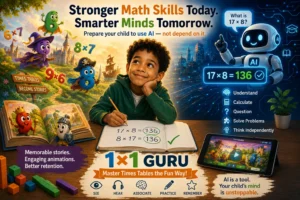
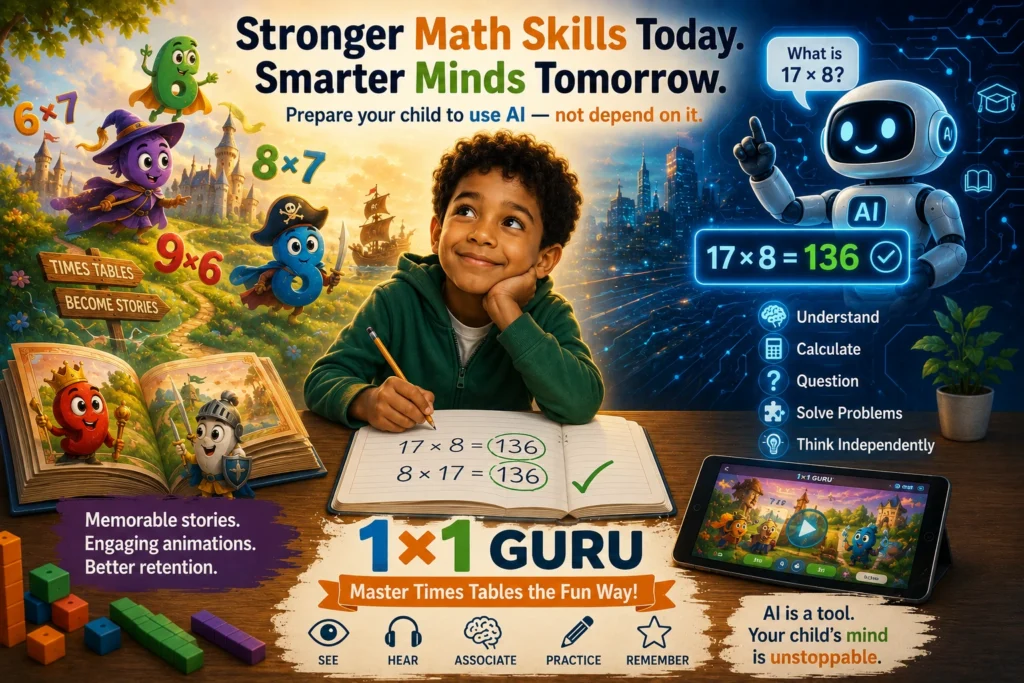
1×1 Guru is designed to help children learn and remember multiplication facts through a more visual and associative approach.
Instead of presenting only:
7 × 8 = 56
the method uses stories and animations connected to multiplication facts.
The idea is to give children an additional mental reference that may help them retrieve the answer later.
Rather than seeing multiplication only as abstract numbers on a page, children can connect those numbers to memorable visual situations.
The program uses animations for fundamental multiplication combinations and takes advantage of the commutative property of multiplication.
For example, once a child learns:
7 × 8 = 56
the same knowledge can be applied to:
8 × 7 = 56.
This reduces unnecessary repetition while helping children build familiarity with multiplication facts.
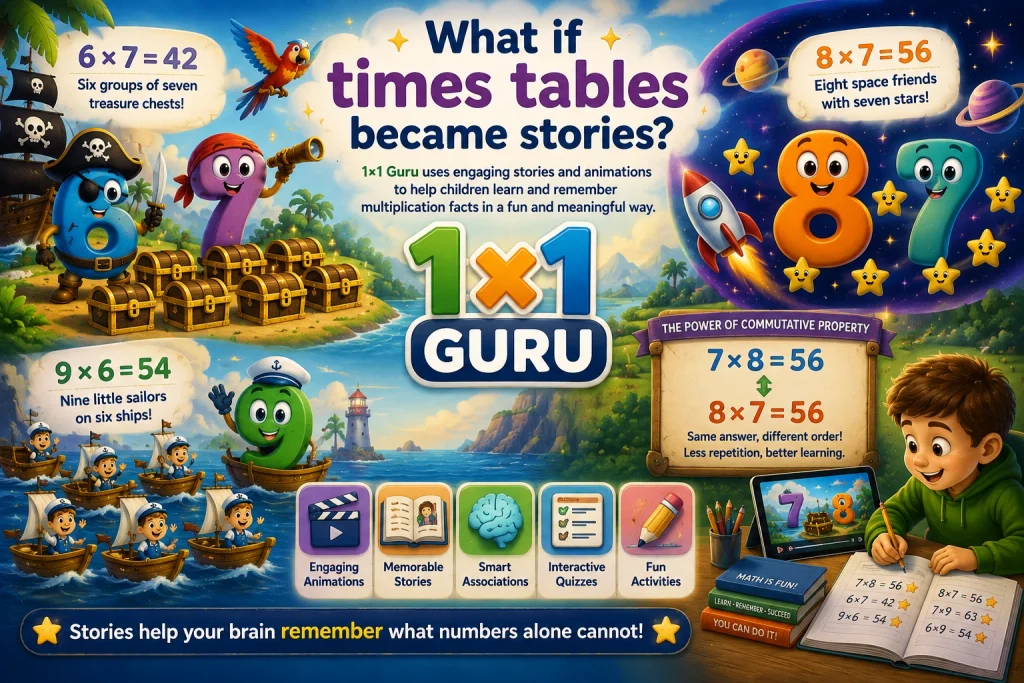
Suggested image: A colorful educational illustration in which numbers become friendly characters inside a mathematical adventure. Multiplication facts such as 6×7, 8×7, and 9×6 appear around them.
Text on image:
“What if times tables became stories?”
🔢 See How 1×1 Guru Can Help My Child 🧮(Official Website)
7. 🎨 See, Hear, Associate, Practice, and Remember
One interesting aspect of this approach is that learning is not limited to reading numbers on a page.
The experience can involve different forms of interaction, including:
- 🎬 Animations
- 📖 Stories
- 👂 Audio
- 🎨 Activities
- ❓ Quizzes
- 🧠 Associations
- 🔄 Repetition
The learning process can be summarized as:
👀 SEE → 👂 HEAR → 📖 ASSOCIATE → 🧠 REMEMBER → ❓ ANSWER → 🔄 REINFORCE
Repetition has not disappeared.
Instead, repetition becomes part of a richer learning experience.
For children who struggle with traditional memorization, visual and narrative associations may provide another pathway for remembering multiplication facts.
🔢 See How 1×1 Guru Can Help My Child 🧮
8. 🧠 Memorizing Times Tables Is Not “Old-Fashioned Education”
There is an important question in modern education:
If we have calculators, computers, smartphones, and Artificial Intelligence, why should children still memorize multiplication facts?
Because having access to information is not the same as knowing it.
Consider this calculation:
8 × 7 + 6 × 4
A child with strong multiplication fluency may quickly recognize:
56 + 24 = 80.
Another child may need to interrupt the reasoning process several times to calculate or search for each multiplication fact.
Basic knowledge that can be retrieved quickly becomes a mental tool for solving larger problems.
Reading provides a useful comparison.
An experienced reader does not consciously decode every individual letter in every word.
Many parts of reading have become automatic.
That automaticity allows the reader to focus on something more important:
understanding the meaning of the text.
Mathematics works in a similar way.
Fluency with fundamental facts can allow children to dedicate more mental attention to higher-level reasoning.
🔢 See How 1×1 Guru Can Help My Child 🧮(Official Website)
9. 🚨 Now Add Artificial Intelligence to the Equation
Imagine a child asking:
“What is 17 × 8?”
Artificial Intelligence immediately answers:
“136.”
Problem solved?
For the machine, yes.
For the child’s education, the answer is more complicated.
If the child already understands multiplication and is using technology to speed up part of a larger task, that is one situation.
But if the child automatically asks AI simply to avoid thinking, that is something very different.
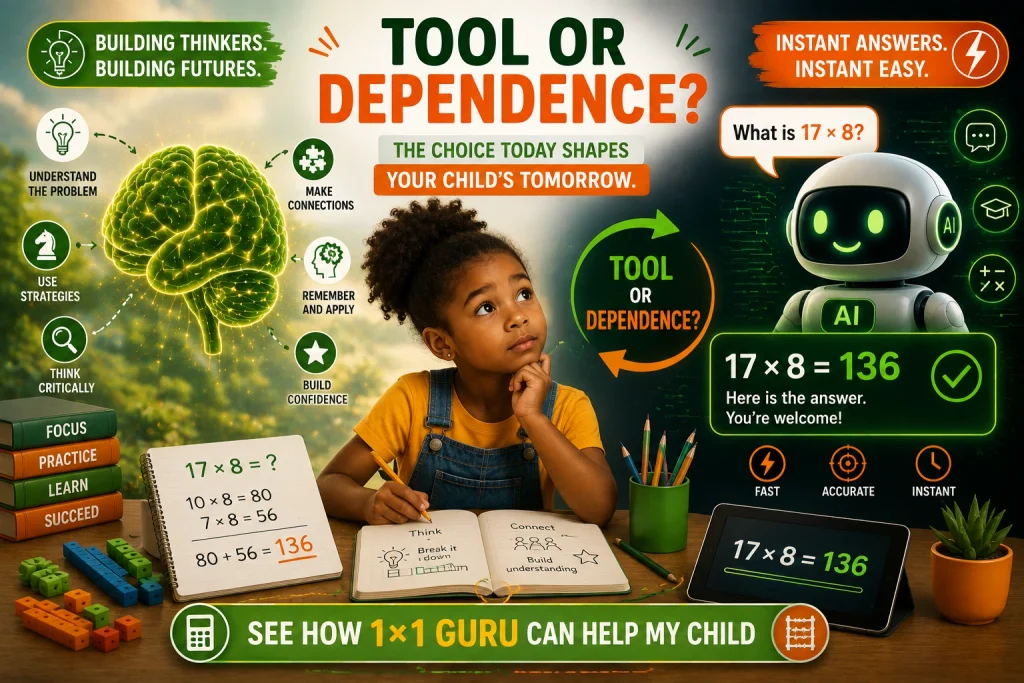
Suggested image: On one side, a child’s brain making connections between numbers. On the other side, an AI system instantly displaying the answer. Between them is the question: “Tool or dependence?”
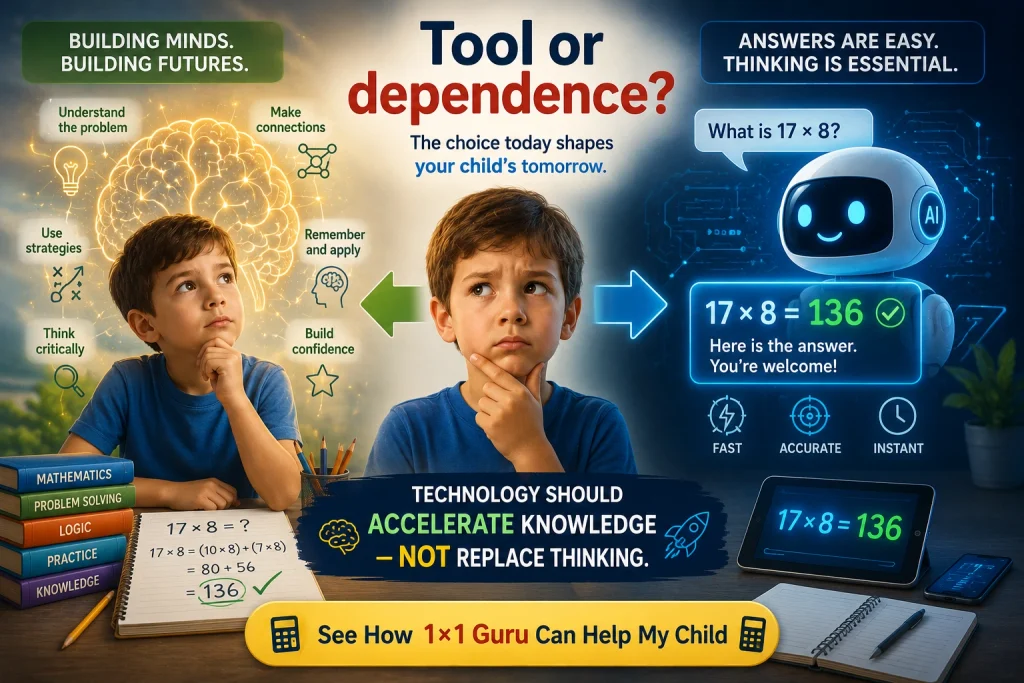
Text on image:
“Technology should accelerate knowledge — not replace thinking.”
🔢 See How 1×1 Guru Can Help My Child 🧮(Official Website)
10. 🤔 What Happens When Children Can Ask AI but Cannot Check Its Answers?
This may become one of the most important educational questions of the next generation.
Artificial Intelligence can make mistakes.
A calculator can receive incorrect information.
An online source can be wrong.
A problem can be misunderstood.
A prompt can be poorly written.
Technology does not remove the need for human judgment.
It increases its importance.
Imagine an AI system telling a child:
8 × 9 = 63.
A child with strong mathematical fluency can immediately recognize:
❌ Something is wrong.
A child who depends entirely on technology may have much more difficulty recognizing the error.
This illustrates an important principle:
Children need knowledge in order to evaluate the information technology gives them.
In an AI-powered world, independent thinking may become more valuable, not less.
🔢 See How 1×1 Guru Can Help My Child 🧮(Official Website)
11. 🧒 AI Should Support Children’s Intelligence — Not Replace It
We do not need to choose between:
🧒 CHILD OR 🤖 AI
A much better model is:
🧒 CHILD + 🤖 AI
First, children build foundations.
They learn.
They remember.
They calculate.
They solve problems.
They make mistakes.
They try again.
They develop reasoning.
Then Artificial Intelligence can help them explore more advanced ideas, receive explanations, investigate new subjects, and learn faster.
In this model, AI becomes an educational amplifier, not a replacement for basic thinking.
This distinction may become extremely important over the next decade.
🔢 See How 1×1 Guru Can Help My Child 🧮(Official Website)
12. 👨👩👧 Parents Will Have an Important Role in the AI Era
Giving a child access to a screen has never been easier.
The important question is no longer simply:
“How much screen time does my child have?”
We should also ask:
“What is my child doing during that screen time?”
Technology can be used for:
🎮 Entertainment
📱 Passive consumption
🤖 Instant answers
But it can also be used for:
🧠 Learning
🔢 Mathematics
🌎 Discovery
💡 Creativity
📚 Education
Parents can begin asking better questions.
Is my child consuming or creating?
Copying or understanding?
Receiving answers or investigating them?
Avoiding challenges or overcoming them?
Technology itself does not determine the answer.
How we use technology matters.
Suggested image: A parent accompanying a child who is using a tablet to practice mathematics. Friendly numbers and educational characters appear on the screen.
Text on image:
“Technology can also be a powerful learning tool.”
🔢 See How 1×1 Guru Can Help My Child 🧮(Official Website)
13. ⚖️ Does 1×1 Guru Replace Traditional Mathematics Education?
No.
And it should not.
A child should not simply memorize:
4 × 3 = 12.
The child should gradually understand what multiplication represents.
For example, multiplication can describe equal groups:
4 groups of 3 objects = 12 objects.
Understanding matters.
But fluency matters too.
A balanced approach combines:
🧠 UNDERSTAND + 🔄 PRACTICE + ⚡ AUTOMATE + 🧩 APPLY
A tool such as 1×1 Guru can be used as a complement to mathematics education, particularly during the practice and memorization of fundamental multiplication facts.
It should support mathematical learning, not replace mathematical understanding.
🔢 See How 1×1 Guru Can Help My Child 🧮(Official Website)
14. 🌱 The Mathematics Children Learn Today Will Follow Them for Years
Times tables may appear to be a small part of elementary education.
But multiplication is connected to many subjects children will encounter later, including:
- ➗ Division
- 🍕 Fractions
- 📊 Percentages
- 📐 Geometry
- ⚖️ Ratios and proportions
- 💰 Financial mathematics
- 📈 Algebra
- 🧮 Mental calculation
- 🧩 Problem-solving
Weak foundations can create difficulties that appear repeatedly throughout a student’s education.
This is why strengthening the basics matters.
Teaching a child that:
9 × 7 = 63
is not only about answering one multiplication question.
It is about building a mathematical tool that can be used again and again.
🔢 See How 1×1 Guru Can Help My Child 🧮(Official Website)
15. 🔄 Before Giving the Answer, Give Your Child Time to Think
There is a simple habit parents can introduce at home.
When your child asks:
“What is 7 × 8?”
instead of immediately answering:
“56.”
try asking:
“What do you think the answer is?”
Wait.
Give your child a few seconds.
Let the brain search for the information.
If the answer is wrong, that is okay.
Mistakes are part of learning.
Help after the attempt.
This small space between the question and the answer creates an opportunity for mental exercise.
And this principle extends far beyond multiplication.
Before searching online…
Before opening the calculator…
Before asking Artificial Intelligence…
Try to think.
Technology can provide the answer afterward.
🔢 See How 1×1 Guru Can Help My Child 🧮(Official Website)
16. 🚀 Prepare Your Child to Use AI — Not Depend on It
Our children will probably live in a world where Artificial Intelligence is everywhere.
At school.
At university.
At work.
On smartphones.
Inside software.
In vehicles.
Across industries.
Throughout their professional lives.
Trying to prepare children for a world without AI makes little sense.
That world is disappearing.
Instead, we should prepare them for something far more important:
A world full of Artificial Intelligence, inhabited by human beings who still know how to think.
That preparation begins with fundamental skills.
Read.
Interpret.
Calculate.
Question.
Solve.
Make mistakes.
Try again.
Learn.
Technology will continue to evolve.
But some of the most valuable tools your child will ever possess will remain inside their own mind.
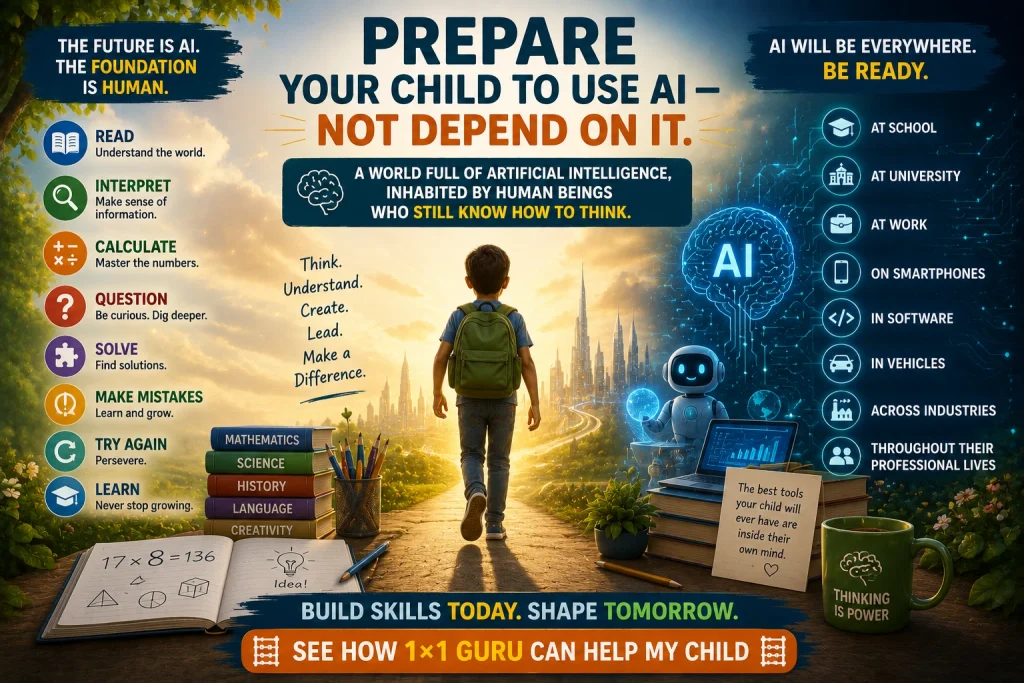
Suggested image: A child walking toward a bright future surrounded by mathematics, books, creativity, technology, and AI elements.
Text on image:
“Prepare your child to use AI — not depend on it.”
🔢 See How 1×1 Guru Can Help My Child 🧮(Official Website)
17. 🎯 Is 1×1 Guru Right for Your Child?
If your child is beginning to learn multiplication or is having difficulty remembering times tables, 1×1 Guru offers an alternative to traditional repetition.
Through stories, animations, visual associations, quizzes, and activities, the program aims to make multiplication facts more memorable and engaging.
It is not intended to replace school.
It does not replace teachers.
It does not replace mathematical understanding.
And it certainly should not replace thinking.
Instead, it can provide another educational tool for building mathematical fluency during an important stage of childhood development.
In a generation surrounded by instant answers, one of the greatest gifts we can give children may be the ability to stop, think, and search their own minds before asking a machine.
🧠 Teach Your Child to Think Before Asking AI
Artificial Intelligence will become more powerful.
Calculators will become smarter.
Educational technology will continue to evolve.
But strong foundations will continue to matter.
Help your child build those foundations today.
🔢 See How 1×1 Guru Can Help My Child 🧮(Official Website)
Discover a more visual, engaging, and memorable approach to learning times tables.